Clarity
In the early days of a startup, if you wanted to know what anyone was working on, you could just lean right over and ask them. As companies grow, it becomes impossible for one person to know what everyone is working on. It's just too much information.
We asked Mark Mullen, one of ours investors, on how to improv communication @ Straddle. He said:
"I think you mean planning. Communication and planning are interchangeable."
In other words, plan well and you will communicate well.
None of us need to know what every individual is working on. Knowing at least what every department's (or domain's) priorities are, though, is a key part of having clarity. If people don't have true clarity around what they're doing and how it fits into their organization, they're bound to duplicate efforts, deflate morale, spend hours on unimportant tasks, and more.
When people don’t know the order of operations, you get confusion, tension, drama. People get territorial because someone is already doing what they think they should be doing. And all you see are emails and meetings asking the same question over and over, ‘What are you working on this week?’
When the details of projects, including who is responsible for what, exists outside a manager’s head, and you make all this information available to everyone, you spread out accountability. It suddenly becomes very clear when someone has dropped the ball, or if someone doesn’t have time to take on more work, or if more steps need to be taken before launch. Everyone is responsible for seeing and understanding the situation.
When management is freed up, they can focus their energy on more important things: Developing their people, providing important context around projects, upgrading tools. They’re no longer spending all their time and energy simply serving as an information conduit. If your manager already knows what you’re working on and the status of your work, you can use that meeting time that would otherwise be about what you did that week to talk about how you want to develop in your role, how you want to participate in the future of the company, etc. This is how great companies grow their futures.
- Asana’s Justin Rosenstein on the One Quality Every Startup Needs to Survive
There are six questions that everyone should be able to answer for them to have clarity:
-
What are you working on right now?
-
Are you confident that it's the most important thing you could be doing?
-
Do you know who is waiting on you?
-
Do you know who you can go to for support?
-
Do you know how your work fits into the overarching product we're trying to create?
-
Do you know why that product matters?
Or to summarize, clarity is composed of clarity of purpose, clarity of the plan, and clarity of responsibility.
The Pyramid of Clarity
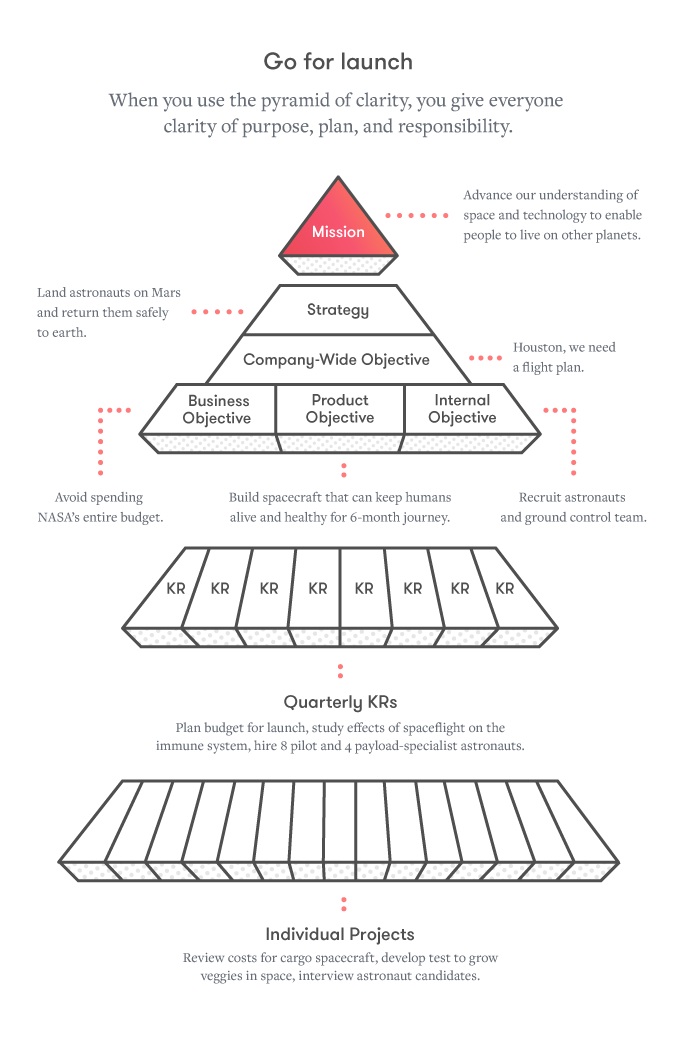
The Pyramid of Clarity shows how our longer-term aspirations are built on top of shorter-term goals. We regularly refer back to it to help us stay on the same page, build confidence in our strategy and execution, and help individuals make decisions that are in line with the big picture.
The Pyramid of Clarity is a simple hierarchy of mission, strategies, objectives, and key results. We prefer it over classical OKR systems because it's simpler (less hierarchy) and still manages to incorporate a larger mission.
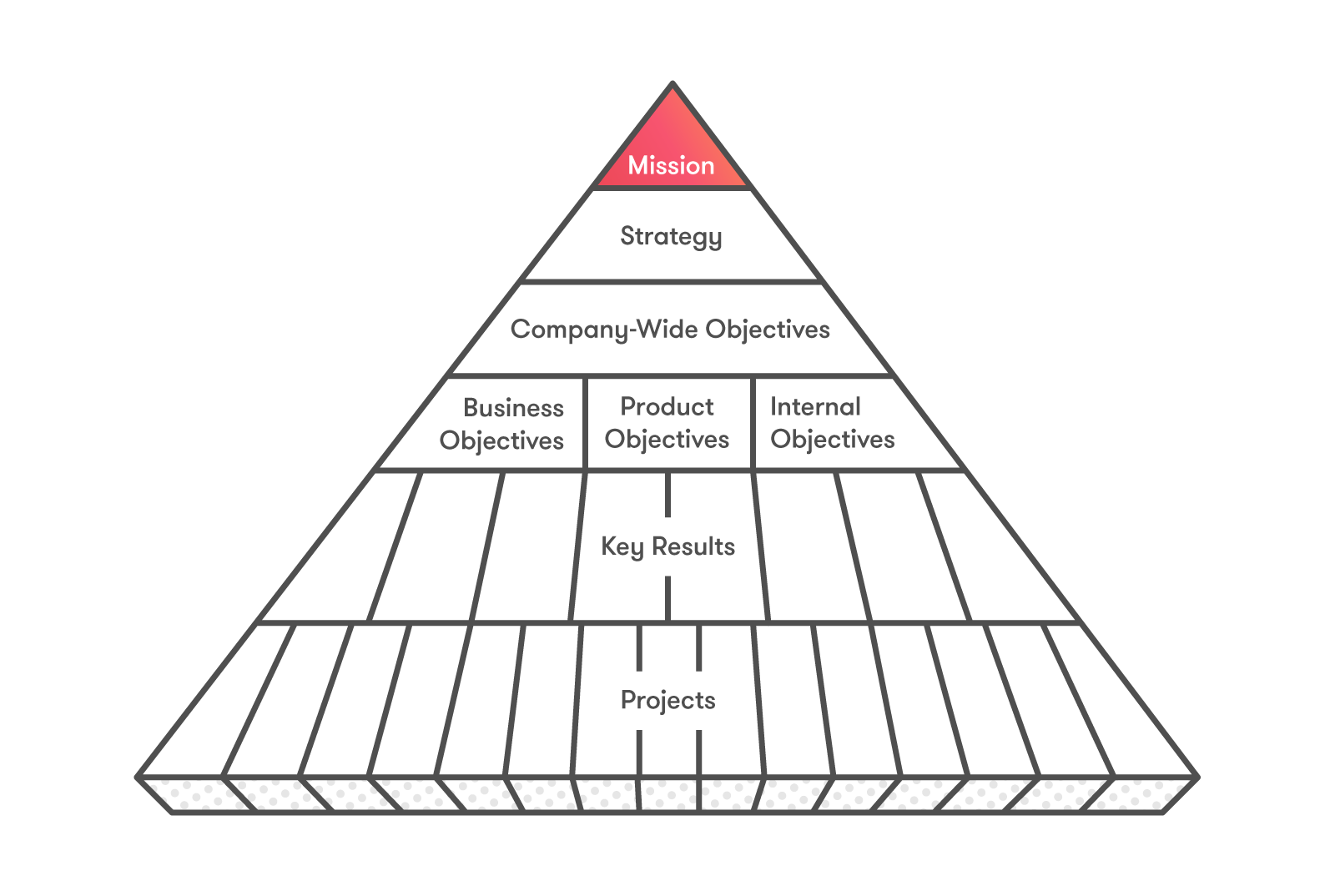
This may seem like a lot of overhead, but you either pay the price of using this framework to consistently communicate (and how well you are performing) or you don't, and you have to respond on the backend to people who don't understand or get off track.
Mission
Great missions are short, clear, and could be stitched on a pillow. Things to remember about a good mission:
-
Keep it high level. In general, a good mission tells someone who has never heard of your company not only what you do, but also why you started the business.
-
A good litmus test: If you tell your mission to a stranger, they can see why you're spending your life working on that.
-
Tread the line between missions that are sufficiently broad and motivating, and those that are also specific enough. If you find yourself not referring to it a lot, it's not the right specificity.
Good examples:
-
Asana: Enabling the world's teams to work together effortlessly
-
Stripe: Increase the GDP of the internet
-
Airbnb: Belong anywhere
-
Google: Organize the world's information
-
Nike: Bring inspiration and innovation to every athlete in the world
Strategies
If the mission is the "why" (inarguable because it's about passion), your strategies are "how" you will do it.
At Straddle, we generally have 3-4 strategies for each year. These are the major pillars of how we're going to achieve our mission.
Example strategies might be:
-
Build the best product in our category
-
Generate enough revenue to sustain the business and attract high quality stakeholders
-
Build the best team
-
Continuously improve unit economics to build a business capable of growth in times of boom and bust
Objectives
At the tactical level, objectives are the tactical goal posts along the way toward accomplishing the strategies and ultimately the mission.
Examples of objectives:
-
Create a predictable product development process
-
Create relationships with all of our target accounts (Engagement, MQLs, Predicted Pipeline)
-
Strengthen our culture of regular, candid bidirectional feedback
-
Sustain a highly collaborative, inclusive, and remote-friendly culture
Key principles:
-
Objectives map to the strategies (and drive them). If you have big objectives that don't map to your strategies, it's a sign that your strategies should be tweaked.
-
We have a flat list of objectives and key results that don't inherit from one another. Cascading OKRs don't work because it's confusing and results in sub-OKRs getting hidden and forgotten about.
-
Objectives should be realistically achievable within the year
-
Objectives generally aren't quantifiable—that's the role of key results (covered next)
-
Objectives are owned by a leader (typically someone on the leadership team)
-
The key is to be clear and simple
If you find that parts of the organization are resisting negatively to the idea of objectives (or key results) in principle, rather than taking issue with a specific objective, that's a red flag. It's important to identify those people early—many of them tap out because they don't like scrutiny on their prioritization or work.
Key results
Key results are measurements against your objectives to show how you're performing against them. Every team will write key results against the various company objectives. They are refreshed quarterly.
Key results are:
-
Clearly defined
-
Owned by a single person (usually a team lead or IC leader)
-
Objective, in that a third party should be able to confirm their current status
-
Ideally an integer value (rather than a true/false Boolean that has no concept of progress over time)
Whoever owns the key result should either have total control over the outcome (i.e., successfully achieving the key result doesn't hinge on teams that aren't reporting to them) or be an executive.
It's important that the team feels autonomy and agency over moving the key result. They shouldn't have to rely on other teams not under their control to achieve success.
Phrasing key results for clarity:
We use this format to communicate progress: From X to Y in metric
Examples:
-
From $10M to $20M in ARR
-
From 10s to less than 1s in page load time
-
From unknown to 40% 30d retention
Or written differently to achieve the same effect:
- Generate $20M ARR (up from $10M in Q2)
This communicates clearly how much velocity will be required to meet that goal and whether there's a baseline available for it or not.
Initiatives
Lastly, initiatives are small groups of projects that aim to drive progress against key results. They are made up of small units of work at the individual contributor level. They should be completely under the control of whoever owns them.
Recording OKRs at Straddle
Our OKRs (will be) stored in Notion. We create a hierarchy for each planning period (typically annual for objectives, quarterly for key results).
Updating key results
Key results should be reviewed regularly in one-on-ones. The owner of each key result should update their progress and flag any blockers or risks.
For ICs that don't directly own a key result, their initiatives driving work toward the key result should be tracked in Notion and referenced in their one-on-ones.